
Why B2B ROAS is different
B2B Return on Ad Spend (ROAS) differs from B2C because revenue rarely follows an immediate checkout. Longer sales cycles, multi-person buying groups and CRM-based pipeline stages mean paid media must be measured against qualified opportunities and revenue, not just leads or platform-reported conversions.
ROAS measures the revenue returned for each unit of advertising spend:
ROAS = Revenue Generated from Advertising ÷ Advertising Spend
In B2B, revenue may arrive months after the first click, several stakeholders may influence the purchase, and closed-won data usually sits in a CRM, not an ecommerce cart. A content download, a demo request and a sales opportunity do not carry the same commercial value, even when a platform counts them as identical "conversions."
Use ROAS to compare media efficiency, but assess profitability alongside CAC, lifetime value, gross margin, pipeline value and payback period. Attribution built around closed-won outcomes, rather than last-click platform reporting, is what makes that fuller comparison possible in the first place.
ROAS vs. ROI, CAC and pipeline ROAS
Because B2B revenue often develops over a longer sales cycle, ROAS alone does not give a complete view of campaign performance. Pipeline ROAS, CAC and ROI each support a different decision at a different stage of the buyer journey.
| Metric | What it measures | When it's useful | What decision it supports |
|---|---|---|---|
| ROAS | Revenue returned for advertising spend | Comparing campaign efficiency when revenue is tracked reliably | Whether a campaign generates enough tracked revenue to justify its media spend |
| Pipeline ROAS | Pipeline created for advertising spend | Managing B2B performance before revenue matures | Whether spend is creating enough qualified pipeline to continue or increase investment |
| CAC | Cost to acquire a customer | Assessing acquisition economics | Whether customer acquisition costs are sustainable relative to customer value and margin |
| ROI | Profit return after total investment | Assessing commercial profitability | Whether the overall investment, including costs beyond media spend, is profitable |
Avoid universal ROAS benchmarks. A viable level depends on margin, retention, sales capacity, lifetime value and the time required to recover acquisition costs.
Diagnose the cause of weak ROAS before changing bids
Poor ROAS is a symptom, not a diagnosis. It can result from weak conversion signals, poor targeting, generic landing pages, slow sales progression, incomplete tracking or premature scaling. Find the point where quality declines between click, lead, SQL, opportunity and revenue before changing bids.
Common mistakes that make B2B ROAS look worse than it is
Use this as a quick diagnostic before changing bids or budgets:
- Treating every form fill as equally valuable. A content download, a generic contact request and an enterprise demo can have very different progression rates. Return validated lifecycle stages to reporting before treating lead volume as performance.
- Optimizing automation around weak events. Automated bidding learns from the conversions it receives. If the account sends unqualified form fills as the main signal, the platform may efficiently find more unqualified form fills.
- Sending all paid traffic to a generic homepage. Homepages serve multiple audiences and intent levels. Campaign-specific pages usually give visitors a clearer message, proof and next step.
- Judging campaigns before the sales cycle matures. Early platform metrics may not reflect later opportunity quality or revenue. Review cohorts by campaign, source and acquisition period.
- Relying only on platform reporting or last-click ROAS. Platform reports are useful for optimization, but they don't prove causation. Compare CRM outcomes and use controlled tests for material budget decisions.
- Scaling from blended results. A strong average ROAS can hide weak incremental performance. Assess the quality of the next spend increment before expanding budgets.
- Treating attribution as proof of incrementality. Attribution assigns credit among observed touchpoints, while incrementality tests whether advertising produced outcomes that would not otherwise have occurred.
Match the symptom you're actually seeing to its likely cause before you touch a bid:
| Symptom | Likely issue | Recommended action |
|---|---|---|
| High lead volume, few opportunities | Optimizing for low-quality conversions | Review primary conversion actions and CRM lead stages |
| High CPC, low conversion rate | Weak intent or message mismatch | Improve targeting, messaging and landing-page relevance |
| Good leads, weak revenue reporting | Long sales cycle or missing CRM feedback | Review cohorts and connect downstream outcomes |
| Cheap leads after automation starts | Platform is learning from poor signals | Improve conversion quality before relying on automation |
| ROAS falls as budget rises | Lower-quality incremental demand | Review marginal performance before scaling |
How to improve ROAS in B2B paid media: 5 tactics that actually work
Enhancing B2B ROAS goes beyond reducing CPCs or inflating lead counts. It requires refined conversion signals, bidding and messaging synchronised with buyer intent, and a focus on commercial outcomes - scaling only once incremental spend generates qualified pipeline.
1. Optimize for qualified pipeline, not form fills
Platforms optimize toward the events they can see. If the primary event is a generic form fill, they may prioritise cheap completions rather than people likely to buy. The goal is qualified pipeline at a commercially viable cost.
Use a conversion hierarchy. Set a clear progression: lead, MQL, SQL, opportunity, closed-won customer and closed-won revenue. Choose the primary optimization event based on volume and reliability. A new or low-volume account may need an interim signal such as a validated SQL. An established account with reliable CRM feedback can optimize closer to opportunities or value.
Connect CRM outcomes to paid-media reporting. Use offline conversion tracking to return qualified CRM stages to Google Ads, LinkedIn or Meta where appropriate. This reveals which campaigns create opportunities and revenue, not simply enquiries. It depends on consistent lifecycle definitions, source capture, matching capability, consent and reconciliation. If the CRM data is unreliable, fix that before using it to guide bidding.
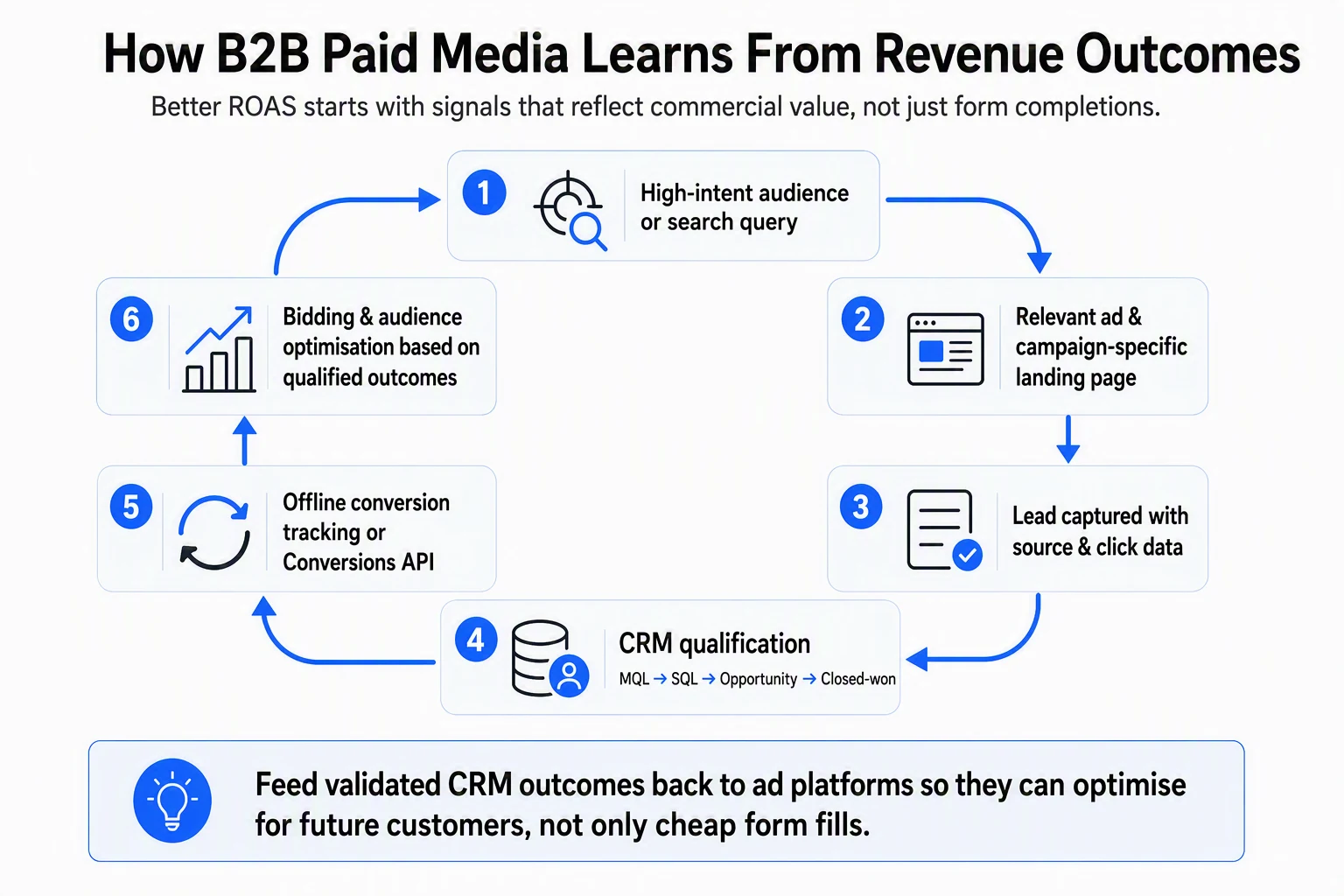
This is the difference between tracking leads and training campaigns on commercial outcomes. In Verto's IRONSCALES programme, the paid programme shifted from form-fill optimization to CRM-based MQL, SQL, opportunity and closed-won signals. The result was a 2.3x increase in marketing-attributed pipeline within 90 days, at the same cost per MQL.
Value lead types differently where data supports it. A demo request, content download and enterprise opportunity should not have equal value. Where historic progression data is dependable, calculate expected values from average deal value and stage-to-opportunity rates. Do not use speculative values - value-based bidding is only as reliable as the commercial data it receives.
For how this fits into overall account structure, see our three-pillar B2B Google Ads framework.
2. Match bidding strategy to data quality and conversion volume
Do not treat a bidding strategy as a universal setting. In low-volume B2B accounts, automation can magnify weak signals. The practical sequence is to establish credible intent, creative, landing-page and conversion-quality baselines first, then test Maximise Conversions once high-intent data is reliable, and consider value-based bidding only after CRM values are consistently fed back.
Once conversion signals are reliable, automated bidding can become an effective way to scale qualified demand. In Verto's SmartRecruiters programme, connecting Marketo and Salesforce opportunity data to Google Ads enabled a shift to Maximise Conversions using deeper-funnel signals. Within 90 days, opportunity volume increased 4x while paid-media budget was reduced by 50%.
"Partnering with VertoDigital transformed our Paid Media performance in 90 days. We 4X our opportunity creation, with a 50% reduction in budget, improved management of our investment and created a more predictable pipeline contribution engine."
Steve Hardy, CMO, SmartRecruitersWhen target ROAS or value-based bidding may be viable. Target ROAS and value-based bidding become more appropriate when conversion values reflect genuine commercial differences, downstream outcomes are returned to the platform and the account has enough reliable data to learn from. Automation is not a shortcut around weak measurement - it amplifies the signals it receives.
3. Improve intent, ad message and landing-page match
Paid media works best when the full journey is coherent: query or audience signal, ad message, landing-page headline, proof, CTA, sales follow-up. Start with what makes good B2B ad copy.
Prioritise high-intent demand capture. For conversion campaigns, focus on category, pricing, alternatives, comparison, use-case and integration terms where relevant. This doesn't mean awareness activity lacks value - it means awareness should be judged against reach, engagement, audience quality, pipeline contribution and later demand creation, rather than the same short-term ROAS threshold used for high-intent search.
Avoid generic homepage traffic. A generic homepage has to serve too many audiences and intent levels. Use campaign-specific landing pages where the audience, offer or use case differs materially. Check that the page:
- Matches the ad's promise.
- Makes the audience and use case clear.
- Shows relevant proof before the CTA.
- Offers a CTA appropriate to buyer intent.
- Collects necessary qualification data without unnecessary friction.
4. Measure pipeline and revenue across the full sales cycle
Closed-won revenue ROAS is commercially meaningful, but it may arrive too late for weekly optimization. Pipeline ROAS or expected-value ROAS can provide interim direction when based on disciplined CRM stages and later reconciled against revenue.
Use attribution for diagnosis, not proof of causation. Attribution distributes credit among touchpoints associated with a deal. Incrementality asks whether advertising generated additional outcomes that would not otherwise have happened. Use attribution to understand patterns, then validate major budget shifts through controlled tests, holdouts, geo experiments or lift studies where practical.
5. Scale with marginal ROAS, not blended ROAS
Blended ROAS is the average return across total spend. Marginal ROAS is the return from the next increment of spend. The difference matters because early budget often captures the strongest demand; additional spend can enter pricier auctions or reach lower-intent audiences.
Set a viable threshold based on margin, CAC and payback. Increase budgets in controlled steps, then review the incremental lead quality, cost per opportunity, pipeline and revenue. Pause, adjust or reallocate spend when incremental performance falls below the agreed threshold.
A complimentary pipeline assessment connects your ad platforms to CRM outcomes and shows exactly where spend is - or isn't - creating qualified pipeline, in 5 business days, no commitment.
Free Pipeline AssessmentA 90-day roadmap for boosting B2B ROAS
Sequence the work in stages. Some fixes depend on data you build earlier, and testing bidding on unreliable signals wastes the whole quarter.
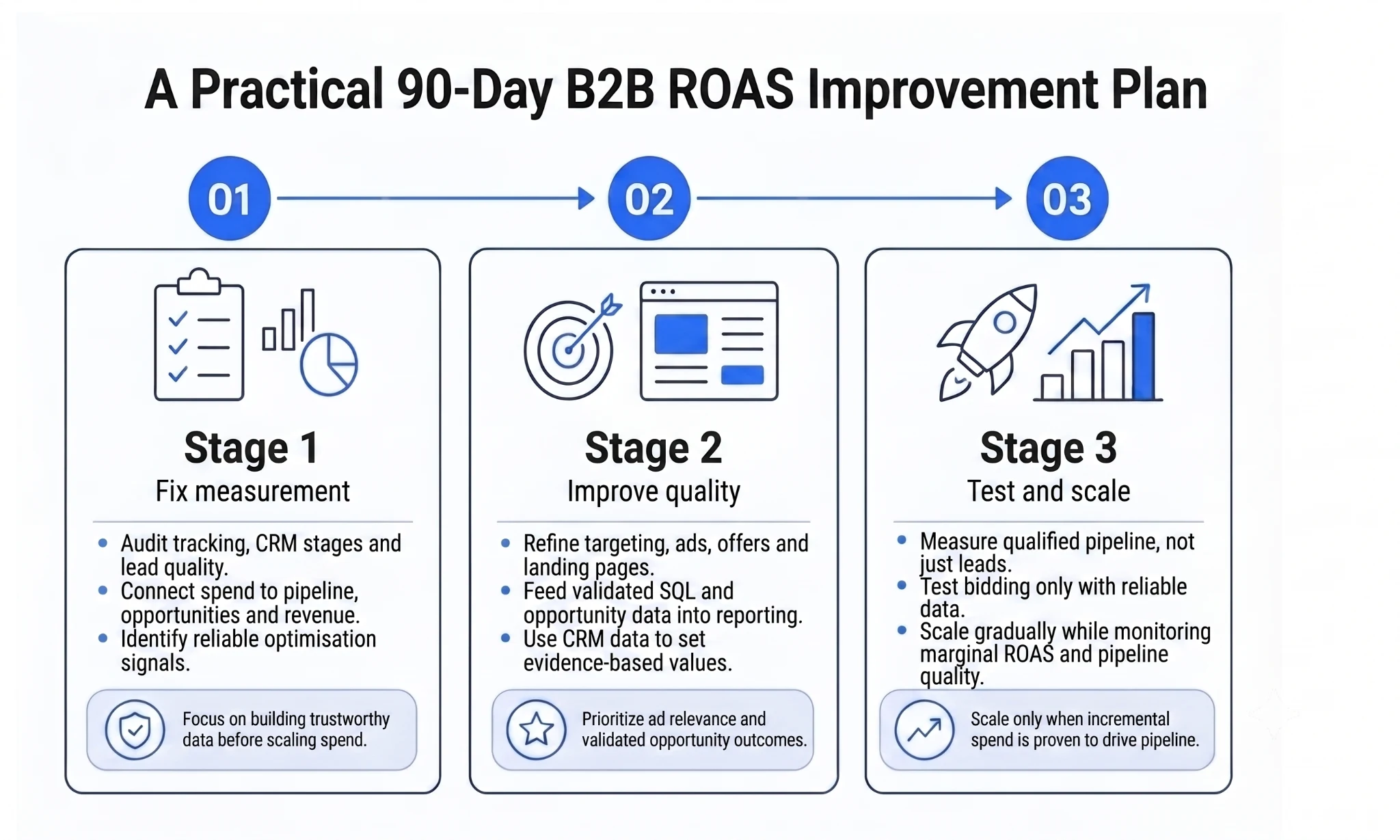
Stage 1 (Days 1-30): Diagnose and repair measurement
- Audit conversion actions and remove duplicate or low-value events.
- Review CRM lifecycle stages and qualification definitions.
- Check UTMs, source capture and campaign-level lead quality.
- Build reporting from ad spend through qualified pipeline, opportunities and revenue.
- Identify which downstream outcomes are reliable enough to guide optimization.
Stage 2 (Days 31-60): Improve traffic and conversion quality
- Review search terms, targeting, exclusions, offers, ad messages and landing pages.
- Improve alignment between the ad promise and the landing-page experience.
- Return validated SQL and opportunity outcomes to campaign reporting.
- Use CRM history to assign conversion values only where evidence supports them.
- Prioritise traffic sources and campaign segments that produce qualified demand.
Stage 3 (Days 61-90): Test bidding and scale carefully
- Review performance using qualified pipeline and opportunity creation, not lead volume alone.
- Test automated bidding only where conversion signals are sufficiently reliable.
- Scale proven segments in controlled budget increments.
- Assess marginal ROAS, cost per opportunity and pipeline quality after each increase.
- Expand further only when incremental spend continues to generate qualified pipeline.
FAQ
What are the best practices for improving ROAS in B2B advertising?
Optimize towards qualified pipeline, not generic leads. Connect CRM outcomes to campaign reporting, align ad messages with landing pages, and use bidding strategies that match the quality and volume of available conversion data. Assess ROAS alongside opportunity creation, CAC, margin, pipeline and payback.
What is a good ROAS for B2B paid media?
There is no universal good ROAS for B2B. A viable target depends on margin, customer lifetime value, retention, sales-cycle length, sales capacity and payback period. A lower initial ROAS can still be commercially sound if it generates high-quality opportunities and profitable customers.
Should B2B teams use target ROAS bidding?
Use target ROAS bidding only when conversion values represent real commercial value, CRM outcomes are reliably returned to the platform and the account has enough quality data to learn from. It is not a substitute for accurate measurement or qualified demand.
How long does it take to improve B2B ROAS?
A measurement audit can reveal issues quickly, but meaningful improvement must reflect the sales cycle. Allow time to repair tracking, validate lead quality and observe pipeline progression.
How can a campaign help if it has low last-click ROAS?
A campaign may influence demand that converts later through another touchpoint. Review cohort performance and pipeline contribution, then validate important decisions with incrementality testing where feasible.
Improving B2B ROAS starts with improving what the account learns from. Train platforms on high-intent signals, evaluate results in commercial context, and scale only when incremental spend continues to create qualified pipeline and revenue.